
A handicap mark, published on its own, is not information. It is a number.
"Up 4lb to 86." What are you supposed to do with that? Up from what, for what performance, and is 86 a mark the horse can actually win off? Plenty of places will print the figure. Very few will tell you what it means.
The worst version of it, and you will see this everywhere, is a handicap mark displayed next to a horse running in a Group 1. A Group 1 is not a handicap. The mark has no bearing on the race in front of you whatsoever. It is printed because it is available, not because it is useful.
We have spent this summer building the other half of that. Our Tuesday handicap analysis takes the new marks and says what they mean: which rises were harsh, which horses are now well treated, and which race a horse gets into off its new figure. The most recent one is here.
The Horse Database is the lookup that sits underneath all of it.
Every horse, as it stands today
One row per horse. Not a run, not a race, the horse. What official rating it holds now, who trains it now, how old it is now, and how long it has been off.
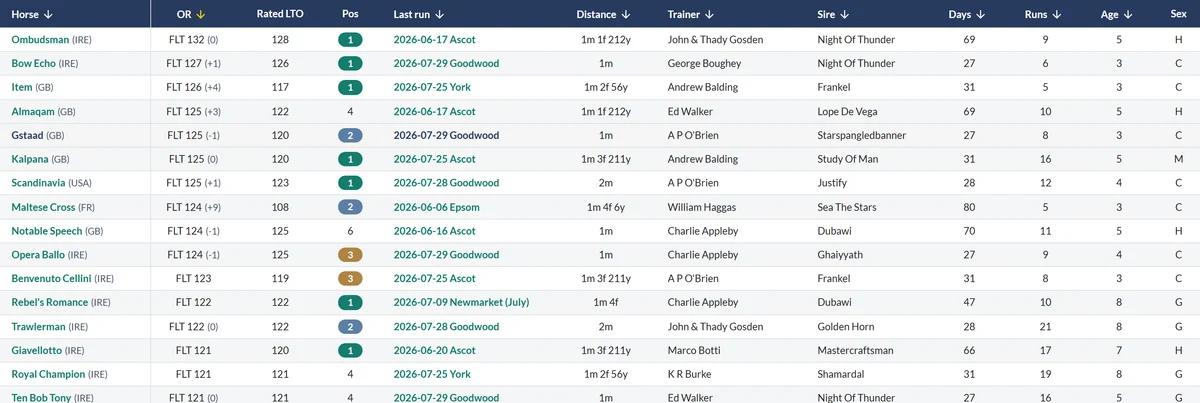
The column that does the work is Rated LTO: the mark the horse actually carried last time it ran, sitting right beside the mark it holds today. When those 2 numbers are miles apart, that is the story.
The thing no results database can show you
Here is why this had to be built separately rather than bolted onto ProStats.
ProStats aggregates runs, and the official rating attached to a run is the mark the horse carried in that race. So a horse that wins its maiden impressively, gets given a mark of 112 by the handicapper and then does not run again is completely invisible to it. There is no run carrying 112. There never was.
That is not a rare edge case. Filter the database to 2yos and it is most of the top of the list.
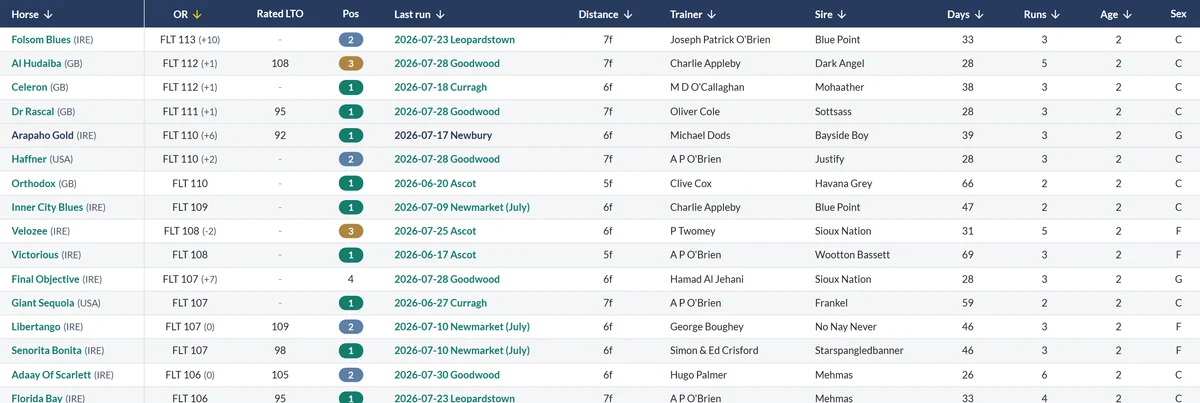
7 of the top 10 two-year-olds have never carried an official mark in a race. Folsom Blues is rated 113, Celeron 112, Haffner and Orthodox 110, Inner City Blues 109, Velozee and Victorious 108. Every one of them shows a dash in the Rated LTO column. They hold those marks on the strength of what the handicapper made of their wins, and not one of them has ever run off a rating.
Of the 3 that have, 2 are carrying enormous gaps anyway: Dr Rascal is 111 having last run off 95, and Senorita Bonita is 107 having last run off 98.
No amount of results analysis will surface those horses, because the data simply is not in the results. This is the only place you can see them.
The filters, and why the discipline selector is not optional
Rating range, age range, sex, days since the last run, minimum runs and distance range, and every one of them goes into the URL, so a search you like is a link you can keep.
The discipline selector matters more than it looks. A horse can hold a Flat mark and a Hurdle mark at the same time, and they can be 40lb or more apart. Ben Hur is rated 78 on the Flat and 124 over hurdles. Asking for "rated 90 to 105" without saying which code you mean is a meaningless question, so we make you answer it. It defaults to Flat.
How it stays current
Official marks change weekly, and this page carries the current list rather than a snapshot taken whenever we happened to build it. When a horse's mark moves, it moves here too, and both the British and Irish marks are kept in step.
The rest of the row, the trainer, the age, the days off and the last run, comes off the horse's most recent run and updates as results land.
What it deliberately does not do
There are no strike rates on this page, no win and place rollups, no aggregation of any kind. That is not an oversight, it is the whole design. ProStats is the system builder and it is very good at it. The moment this page starts aggregating results it becomes ProStats wearing a different hat.
The division is clean. ProStats tells you how horses rated X have performed. This tells you which horses are rated X.
You will find it under Stats, on the Horses tab, at ratingtheraces.com/stats/horses/. It is part of a Professional membership, and there is a help article walking through every column and filter.
A mark on its own is a fact. A mark next to what the horse last ran off, who trains it now and how long it has been off is the beginning of an argument, which is the same reason we bothered with beaten favourite records and headgear records rather than just showing the flag.