
Il Est Francais has been moved to Dan Skelton, and we have just added headgear to the ratings. The two landed at roughly the same time, and between them they made this a very good moment to talk about the headgear angle, because one explains exactly why the other is interesting.
What has been added
Headgear now sits next to the horse's name on every racecard and every horse history. Where a horse is having its first or second run in that gear, we also show you the record of the trainer, the jockey and the sire with that exact piece of kit at that exact point in the sequence.
The codes, what the small numbers after them mean, where to find it all and how to switch it off are covered in our help article on headgear. This piece is about why it is worth looking at in the first place.
Trainer, jockey and sire, and why the sire is the interesting one
Plenty of people already look at a trainer's record with first time headgear. That is a well worn angle and we would not claim otherwise. The jockey, honestly, is the one we expect to matter least. Does it really change much for a rider whether the horse underneath them has cheek pieces on? Probably not. We show it because it costs nothing to show and somebody will find a use for it.
The sire is where we think there is something genuinely new. Headgear is fitted to fix a problem, and a lot of those problems are inherited. If a stallion throws progeny who do not fill their lungs properly, then a tongue strap is going to keep working on his stock, over and over. If his progeny are the sort who look around and lose concentration, cheek pieces will keep sharpening them up. That is a family trait, and it should show up in the numbers.
We are not aware of another card that puts a sire's headgear record in front of you. We think it will turn out to be one of the more useful things on there.
First time headgear is not the signal most people think
Before we get to Skelton, the thing that surprised us. We expected the numbers to show first time headgear as a positive. Across every trainer and every type of gear, it is the opposite.
| First time gear | All trainers | Against their own baseline |
|---|---|---|
| Hood | 989 from 13,504 (7.3%) | -3.3 |
| Blinkers | 1,335 from 15,754 (8.5%) | -2.4 |
| Tongue strap | 1,536 from 18,298 (8.4%) | -2.4 |
| Cheek pieces | 2,264 from 24,847 (9.1%) | -1.8 |
| Visor | 851 from 9,040 (9.4%) | -1.3 |
That last column is the one that matters. It measures each trainer's record in first time gear against what that same trainer manages the rest of the time, so it is not a case of good yards being compared with bad ones. Every single category comes out negative.
Second time out the penalty very largely disappears, somewhere between half a point down and a point up.
Said out loud, it is obvious. Headgear gets fitted because a horse has a problem. It is a response to a horse not performing, so the runners wearing gear for the first time are, by construction, a population of horses that have been going wrong. The old line that first time gear means improvement is, across more than 100,000 runs, simply wrong on average.
Which turns the question on a racecard into a much better one. Not "first time gear, will it improve?" but "this is usually a negative, so is this one of the few yards where it works?"
So is Skelton special? Yes, at one thing
Here are his records, with his own baseline alongside so you can see what the gear is actually adding, and the population figure so you can see what it normally does.
| Gear | Skelton | vs his own baseline | Population |
|---|---|---|---|
| Tongue strap, first time | 22.1% (281 runs) | +3.5 | -2.4 |
| Tongue strap, second time | 20.8% (216 runs) | +2.3 | -0.5 |
| Hood, first time | 23.4% (47 runs) | +4.8 | -3.3 |
| Hood + tongue strap, first time | 20.0% (50 runs) | +1.4 | -2.8 |
| Cheek pieces, first time | 16.4% (140 runs) | -2.1 | -1.8 |
| Cheek pieces, second time | 14.9% (74 runs) | -3.7 | -0.1 |
| Blinkers, first time | 9.4% (32 runs) | -9.2 | -2.4 |
He is not a headgear magician, and it would be lazy to call him one. With cheek pieces he is no better than the crowd, and with blinkers he is a good deal worse.
The tongue strap is the real thing. Plus 3.5 first time and plus 2.3 second time, across 497 runs between the 2, in a category where the average trainer gives up 2.4 points. That is a swing of roughly 6 points against expectation, holding up across both positions and a large sample.
For context, he is third of the 65 trainers with 50 or more first time tongue strap runs, behind Olly Murphy on 22.8% and William Haggas on 22.5%, against a median trainer of 9.8%. Treat that ranking gently: the median is low partly because most of those 65 are simply weaker yards. The baseline column is the honest measure, and it says the same thing.
Which brings us to Il Est Francais
He arrived from France with a serious reputation, and he lived up to it immediately. On Boxing Day 2023 he won the Kauto Star Novices' Chase at Kempton at 13/8, 11 lengths clear and still on the bridle, rated 151 at the time.
He went back to France, came back the following Boxing Day for the King George itself, and ran a blinder. Beaten only by Banbridge, who came and got him late, with L'Homme Presse third and Bravemansgame down the field. He was second at 9/2, rated 156, and at that point he looked like a horse who was going to win a King George of his own.
Then it came apart. Sixth at Cheltenham in March 2025 at a career high rating of 166, and after that 3 straight starts pulled up: Ascot in November at 11/4, Kempton on Boxing Day at 20/1, and Aintree in April at 18/1.

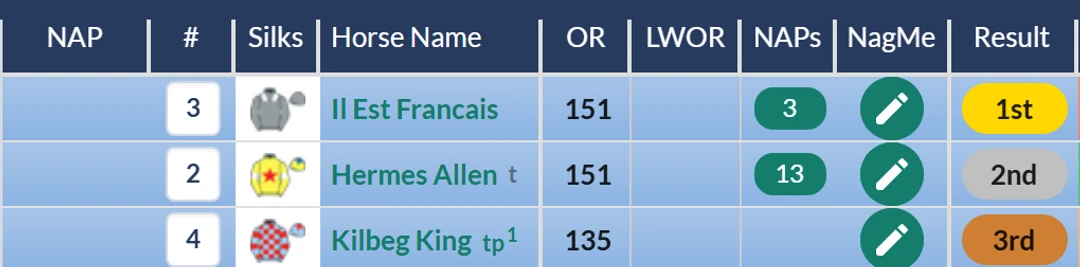
Now look at that image again, because it is the whole argument. He wore a tongue tie for his early starts in France, when he was winning. He came to England, to Tom George as sole trainer after the Kelvin Hughes family bought out the other shares, and he ran without it. The tongue strap only reappears on the very last line, at Aintree in April, by which time he had been pulled up twice already and had lost his confidence and his way entirely.
The gear that had been on him when he was good went missing for the whole of the bad run, and came back too late to fix anything.
Why Skelton is the right man
This is where the two halves of the article meet.
The problem with Il Est Francais is supposed to be his breathing. A tongue strap is precisely the piece of kit for that, and it is precisely what he was wearing when he was winning in France. It is also the one piece of kit Dan Skelton is measurably, repeatedly better with than anyone has a right to be.
That is a narrower claim than we would have made before running these numbers, and a much stronger one for being narrow. We are not saying Skelton is good with headgear in general, because he is not: average with cheek pieces, poor with blinkers. We are saying he is unusually good at the exact thing this horse is supposed to need.
Il Est Francais is now rated 155, 11lb below his peak. That is a mark earned by a horse who was second in a King George, sitting on a horse who currently looks broken. If Skelton gets him right, and if he turns up in a handicap before going back into graded company, that mark is a serious opportunity.
We would not be surprised at all. He has gone to the perfect trainer for the job.