
Trends on the card: what the last winners had in common
Some races keep going to the same sort of horse. Trends sits under the card of most big races and shows you what the last winners had in common, and which of today's runners fit.
Big races have habits. The winners come from a certain age group, they have run well at the course before, they won last time out. Trends puts those habits under the racecard of most Class 1 and Class 2 races, then checks today's runners against them. On a race in the Season Notebook, the Notebook's own panel takes its place. It is a Premium and Professional feature.
Where to find it
Trends is the last of the sections under the ratings grid. Like the others, it starts closed, as a single headline row, so the card stays tidy. Click the Trends row (or Open at its right) to open it, and click again to close it. Opening one section closes any other you had open: see The sections under the racecard for the whole stack.

You will only see it on Class 1 and Class 2 races, the same races that carry the Race History view. Smaller races have no Trends row at all.
Reading the trends
Open it and the first line tells you how many earlier runnings it found: What the last 5 winners of this race had in common. It looks back over up to the last 10 runnings. Some races have not been run every year, or have changed shape, so a race can have fewer.

Each line is one trend, read left to right:
- The trend, in plain words: Won or placed at Cheltenham before, Won last time out, Aged 7 or 9, Rated 135 or higher, 2nd season over fences and so on.
- How many of the winners fitted it: 4 of 5.
- How many of all the runners in those races fitted it: from 23 of 45 runners. This is the part that matters. If 4 of the 5 winners fitted a trend but so did nearly every runner, the trend tells you nothing.
- A strip of years, oldest on the left. Green means that year's winner fitted, dark means it did not, and a dashed square is a year we have no winner for.
Trends marked On the day, such as SP 10/1 or shorter or Favourite won, can only be known once the betting has settled, so they are shown for the winners but not checked against today's runners.
Only trends that rule somebody out
A trend only makes the list when the winners fitted it clearly more often than the runners as a whole did. A line every horse in the field passes is not a trend, it is just a description of the race, so it is left off. That is why one race may show six trends and another only two.
Under the trends, one line sums the winners up: the ages, official ratings, weights and starting prices they came from.
Today's runners against the trends
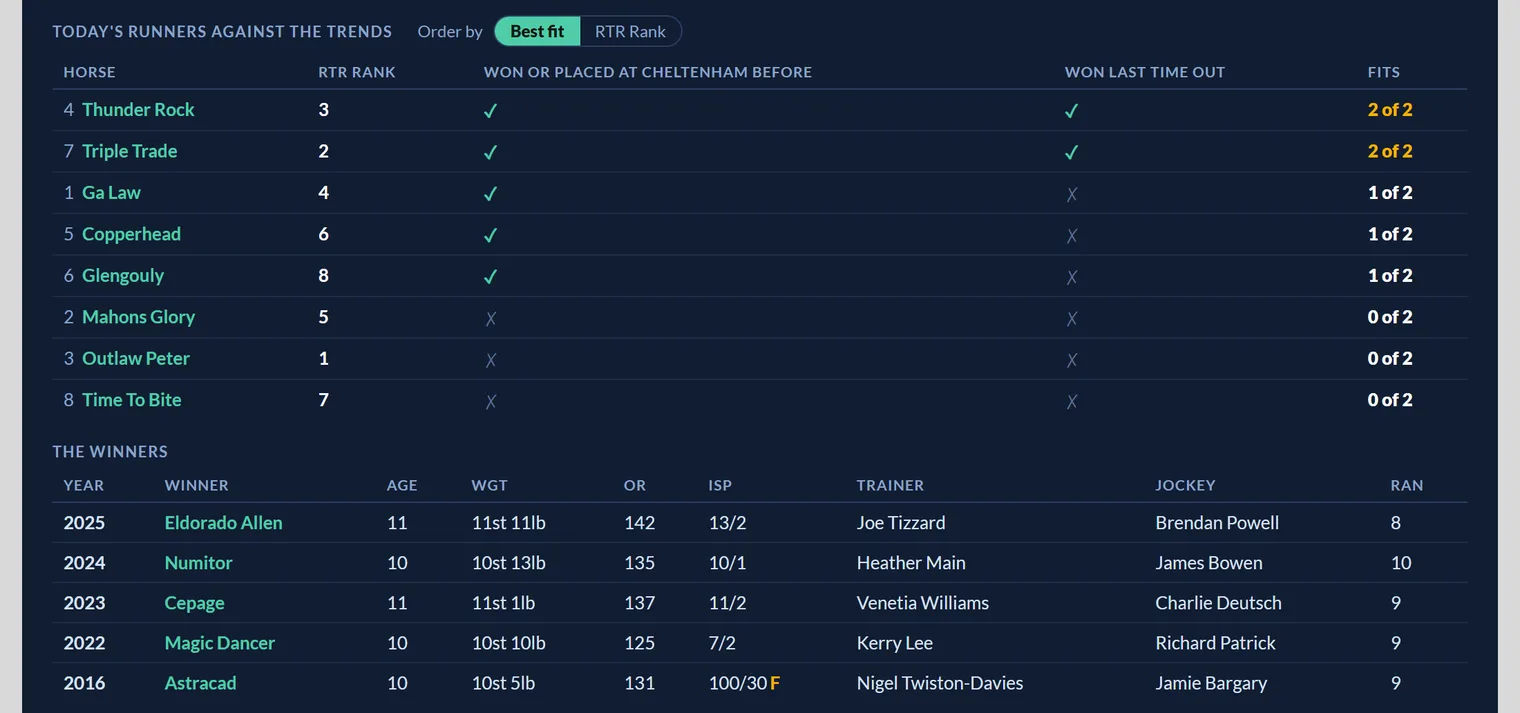
The table below ticks each of today's runners against every trend that can be known before the off: a tick if it fits, a cross if it does not, and a dash where we cannot tell yet. Beside the age, mark and season trends you also see the horse's own figure, so a cross is easy to check.
Fits counts how many of the trends each runner meets, and turns gold when a horse meets every one.
Use Order by to sort the runners by Best fit (most trends met first) or by RTR Rank. The RTR Rank column sits beside the horse either way, and your choice is remembered on this device.
The winners
Last comes the roll of winners, one row per year, with each winner's age, weight carried, official rating, ISP (with F for a winning favourite), trainer, jockey and the size of the field. Click a year to open that year's result, or a winner to open its history.
If a year's running was found under a different race title, it is marked with an asterisk.
Reading it sensibly
Trends describe past winners. They are a handful of races, conditions change, and a horse that misses a trend wins often enough. They are not a tip and we have not tested them as a betting system. Where they earn their keep is as a quick check: a horse that fits every trend, or a well fancied one that fits none, is worth knowing about before you look at the price. Use them alongside the RTR figures and Race History.
Was this article helpful?