
Ch1 and Hu1: a horse's first chase or first hurdle
Switching a horse from hurdles to fences, or from the Flat to hurdles, is one of the biggest changes a trainer makes. Some yards are very good at it. Ch1 and Hu1 show you which.
A horse's first run over fences is a different sport from the one it has been doing. Some yards school them to death and win first time out; others need the run. The same goes for a horse leaving the Flat for hurdles. Ch1 and Hu1 flag every one of those runners on the card, and the hover behind them is where the real detail is. It is a Premium and Professional feature.
The badges
- Ch1 is the horse's first run over fences.
- Hu1 is its first run over hurdles.
They sit beside the horse's name, in the same place as HC1 and the headgear codes. A horse can carry more than one: the runner below is having its first run over fences and its first run in a handicap, so it shows both HC1 and Ch1.
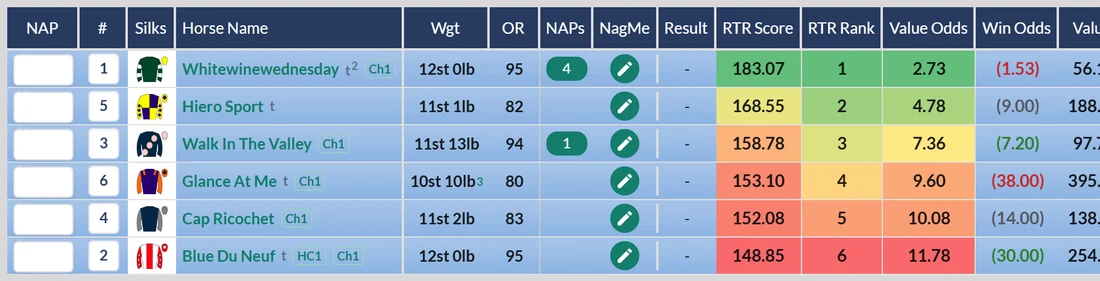
What counts. A first run over fences or hurdles under Rules in Britain or Ireland. Runs abroad and point-to-points do not count, so a horse that has jumped fences in France or between the flags still shows Ch1 here. There is no badge on the Flat, on the all-weather or in bumpers: those are not a jumping debut.
The hover is the point
The badge tells you the horse is new to this. The hover tells you whether that matters, by showing the trainer's record with horses in exactly this position.
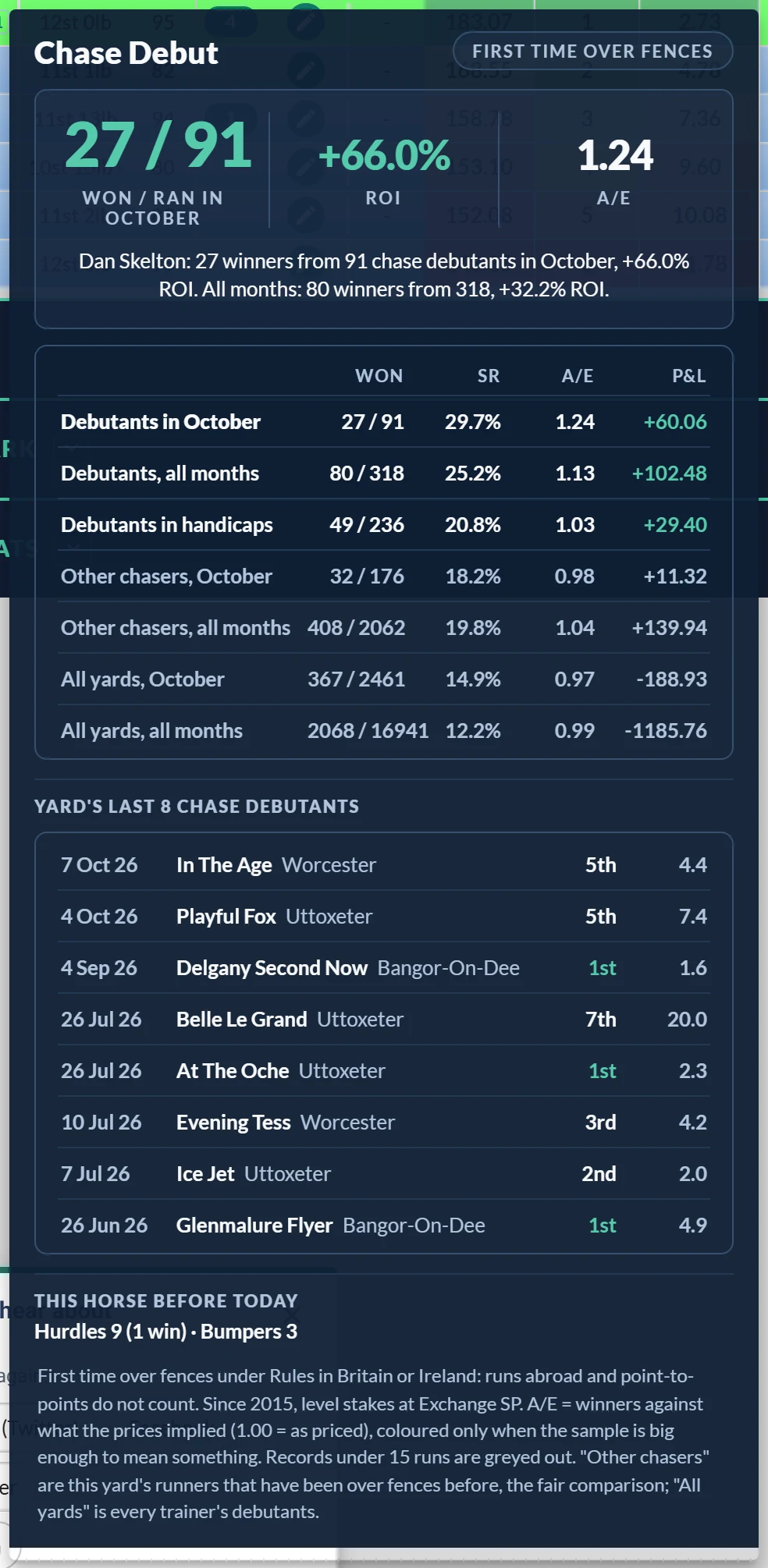
The headline
Won and ran in the current month, the ROI to a £1 level stake, and the A/E. We lead on the month because jumps yards are seasonal: a stable that is deadly with chase debutants in the spring may not have its horses ready in October.
The table
Seven rows, so you can see the figure in context rather than on its own:
- Debutants in October and Debutants, all months: this trainer's first-time chasers or hurdlers.
- Debutants in handicaps: the same horses, narrowed to handicaps.
- Other chasers, October and all months: the same yard's runners that have been over fences before. This is the fair comparison. A trainer with a good debutant record and an equally good record with everything else is just a good trainer, not a debutant specialist.
- All yards, October and all months: every trainer's debutants, so you can see what normal looks like. Across the board it is a losing game, which is the context that makes a standout record worth noticing.
Each row gives Won, SR, A/E and P&L. A/E compares winners against what the prices implied, so 1.00 means the yard's debutants win about as often as the market expects. Figures are to level stakes at Exchange SP since 2015.
Records under 15 runs are greyed out rather than hidden. You can still see them, but the grey is telling you not to lean on them.
The yard's last eight
Underneath, the trainer's most recent debutants by name, with the course, where they finished and the price. Numbers are easy to argue with; eight actual horses are harder. It stops before today's race, so it never spoils the card you are looking at.
This horse before today
Finally, a line on what the horse has actually done: Hurdles 9 (1 win) · Bumpers 3. A chase debutant with thirty hurdle runs behind it is a different proposition from one that has had three.
Training partnerships
Yards change hands, and a record that starts from zero the day a partnership forms is misleading. Where we can see that a new partnership has carried on from a solo trainer, the hover shows you both.
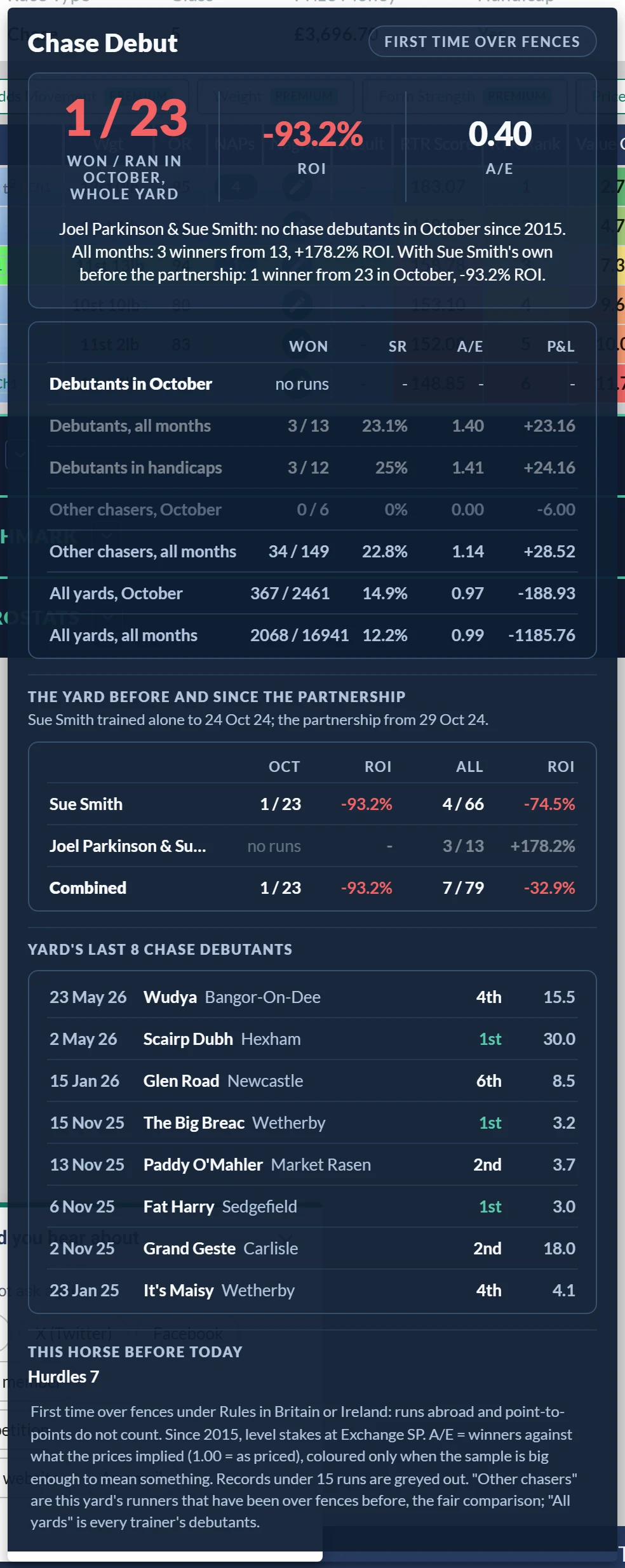
You get three lines, the yard before, the partnership, and combined, with the dates the licence changed underneath. In the example the partnership itself has no chase debutants in October at all, which on its own would tell you nothing; the yard's longer record fills that in.
We link a partnership to its predecessor when enough of the yard's horses moved across and the names overlap, and the links are rebuilt every night. It is a judgement, not a public register, so the odd handover will be missed.
Where else it shows up
- Worth Knowing raises a line when a trainer's debutant record is genuinely strong, rather than on every runner carrying a badge.
- ProStats has a Race Type Debut filter, just under Debutant, so you can test the idea across the database or build it into a system.
Was this article helpful?