
Irish race classes: how we grade races run in Ireland
British races carry an official class from 1 to 7. Irish races don't, so we assign each one a UK-equivalent class, using official ratings wherever possible and prize money only as a last resort. This article explains exactly how, and why.
Race class is one of the most useful ways to read form and filter races: a horse dropping from Class 2 to Class 4 tells you something at a glance. British racing grades every race officially, but Irish racing has never used a class system. Rather than leave every Irish race unclassified, we assign each one a UK-equivalent class so that racecards, class moves in a horse's form and the Class filter in ProStats work the same on both sides of the Irish Sea.
We use three signals, in strict order of trust: the race's pattern status, its official rating ceiling, and only then its prize money.
1. Group, Grade and Listed races
At the top level, Irish and British racing already speak the same language. Ireland runs Group 1, 2 and 3 races on the flat, Grade 1, 2 and 3 races over jumps, and Listed races under both codes, exactly as Britain does. In Britain these are all officially Class 1.
So any Irish race with Group 1 to 3, Grade 1 to 3 or Listed in its title is classed as Class 1, matching its British equivalent.
One deliberate exception: valuable Irish jumps handicaps are labelled Grade A, B or C. Those are handicap gradings, not pattern races, so they fall through to the next two signals.
2. Handicaps: the official rating ceiling
Every Irish handicap has an official ceiling: the highest rated horse allowed to run. It is published in the race conditions as a rating and weight anchor, for example "140 = 11st 12lb", which means a horse rated 140 would carry top weight, so the race is open to horses rated up to 140.
The ceiling is the best quality signal there is, because British classes are themselves defined by rating bands: a British 0-109 handicap chase is Class 5 by definition, a 0-116 is Class 4, and so on. We checked this against two years of British handicap titles and the mapping is essentially perfect.
So an Irish handicap is classed straight from its official ceiling, and prize money is ignored completely:
| Band ceiling | Flat | Jumps |
|---|---|---|
| up to 60 | Class 6 | |
| up to 75 | Class 5 | |
| up to 85 | Class 4 | |
| up to 100 | Class 3 | |
| up to 109 | Class 5 | |
| up to 123 | Class 4 | |
| up to 140 | Class 3 | |
| above | Class 2 | Class 2 |
A 45-65 flat handicap at Galway is Class 5 company whatever it pays, because the same horses in Britain would be running in a Class 5. Even a valuable festival handicap classes on quality first: a big-money handicap hurdle open to horses rated up to 140 is Class 3 company, however much it pays.
For older races from before we started deriving these classes, we use the rating band printed in the race title, for example "(45-65)", where one is present.
3. Everything else: adjusted prize money
For races with no pattern status and no rating ceiling (maidens, novices and older unbanded handicaps) we fall back on the prize money paid to the winner, converted from euros into pounds at the current exchange rate. You will also see the converted figure in pounds on our racecards.
Prize money needs one correction first. Irish prize funds are subsidised, so Ireland pays more than Britain for the same quality of race. We measured the gap directly, by comparing what rating-banded Irish handicaps pay against British races of the same rating band: at everyday level, Ireland pays roughly 20 per cent more. So before banding, we reduce the converted prize by that measured premium. Without this step, a modest race with a generous purse would be flattered by about one full class.
The adjusted prize is then classed by these bands, which we calibrated from what winners actually collected across two years of British racing, class by class:
| Winner's prize (adjusted) | Flat | Jumps |
|---|---|---|
| Class 2 | £13,000 and above | £10,500 and above |
| Class 3 | £7,000 to £12,999 | £5,700 to £10,499 |
| Class 4 | £4,800 to £6,999 | £4,000 to £5,699 |
| Class 5 | £3,800 to £4,799 | under £4,000 |
| Class 6 | under £3,800 | not used |
Flat and jumps band separately because flat races pay around 20 per cent more than jumps races of the same class, and the jumps ladder stops at Class 5 because British jumps racing has almost no Class 6 races. Non-pattern races never class higher than Class 2, which mirrors Britain, where the big handicaps sit in Classes 1 and 2 and everything above that is pattern company.
Including them in ProStats
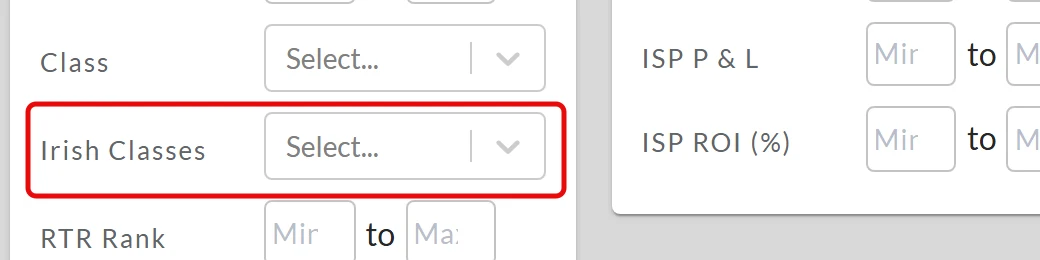
In ProStats, the Class filter counts official British classes only by default, so Irish races sit outside your class buckets and any class-based system you built before this change behaves exactly as it always did. To bring Irish racing in, use the Irish Classes filter directly underneath Class and set it to Include. Your Class filter will then slot each Irish race into the British-equivalent class described above. It's per system, so you can include Irish racing in some and keep others British-only.
Reading Irish classes
A few things worth knowing when you use them:
- Irish classes are our estimate, not an official grading. British classes on our racecards are always the official ones.
- Rated handicaps come out wherever their band puts them, from Class 6 up. Irish maidens and novices mostly come out around Class 4, which reflects their real depth: good Irish maidens are strong races, and plenty of future pattern horses start in them.
- Class moves in a horse's form now work through Irish runs too, so a horse switching between British and Irish racing shows a meaningful class change instead of a blank.
- Northern Irish courses race under Irish rules, so their races are classed the same way; their prize money is already in pounds.
- In ProStats, derived Irish classes are opt-in per system, so any class-based system you built before this change behaves exactly as it always did unless you choose to include them.
Was this article helpful?