
International ratings
When a meeting like Longchamp is worth rating, we build the card with the same algorithms we use at home and put it on its own page for Professional members.
Some overseas days are too good to ignore. For those we build a full RTR card for the foreign meeting and publish it on a separate International Ratings page. It is a Professional feature.
Finding it
On a day we have rated an overseas meeting, an International button appears on the racecards page alongside the usual controls. It only shows on days there is something to see, so if there is no button there are no international ratings that day. From the International page, UK & Irish Racing takes you back.
What's on the page
Every rated race is drawn as a proper racecard, the same shape as the ones you use every day.
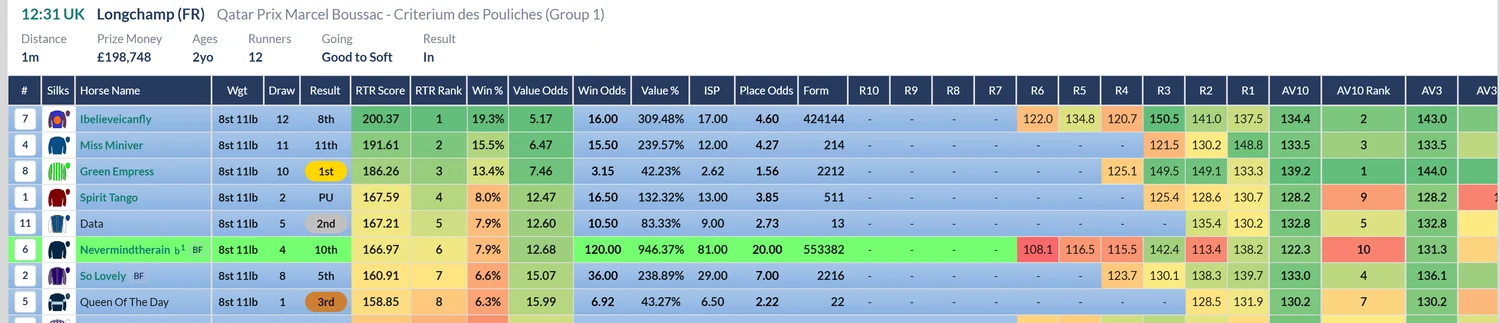
You get the race header with distance, prize money, ages, runners and going, then the field with RTR Score and RTR Rank, Win %, Value Odds, Win Odds and Value %, the ISP, Place Odds, the form string and the R figures and AV columns. Trainer, jockey and sire records come from our own database of their runs.
A few things specific to these cards:
- Times are shown in UK time, labelled as such, so you do not have to do the conversion. The racecourse's own clock may say something different.
- Prices come from the exchange where there is a market, win and place.
- Results arrive later than they do at home. A race is only treated as finished once it has been weighed in, and non-finishers show as PU, F or UR as they would on our own cards. Once a result is in, the run turns up in that horse's history.
Display only, and why
International ratings are for display only. There is a banner on the page saying so. They are built with the same algorithms as our UK and Irish ratings, but:
- They cannot be picked as NAPs, selections or NagMes.
- They are not in any CSV or XLS download.
- They are not counted in any stats, ProStats or TipStats included.
That is deliberate rather than an oversight. Our stats are built on years of consistent British and Irish data, and dropping a handful of foreign races into the middle of it would quietly change every figure you have been measuring against. Keeping these cards separate means your numbers stay comparable.
Was this article helpful?