
Horse ratings sit behind almost every decision in British and Irish racing, from which race a trainer enters, to how much weight a horse carries, to where it starts in the betting. Yet plenty of people who follow racing closely have never had them explained properly.
So here is the plain version: what a horse rating is, who sets the official one, how we build our own, and how the two together produce the angles we write up every week.
What is a horse rating?
A horse rating is a number that estimates how good a horse is, expressed so that any two horses can be compared directly. In British racing the scale runs roughly from the 40s at the bottom of the sport to the 120s and beyond for the best Group 1 performers.
The number matters because a pound of weight is treated as a pound of ability. If one horse is rated 90 and another 80, the handicapper's view is that the first is ten pounds better, so in a handicap the first carries ten pounds more. Get the ratings right and, in theory, they all cross the line together.
The official rating (OR)
The official rating is set by the British Horseracing Authority's handicappers, and it is the one that decides what a horse carries in a handicap. A horse needs three runs (or a win) before it gets one, and from that point the mark follows it around.
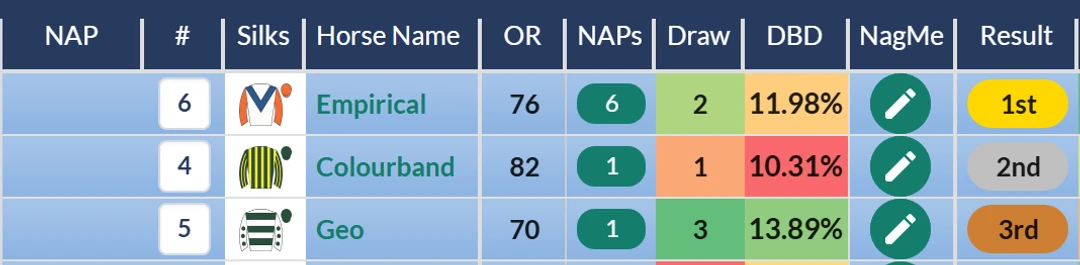
It moves in a fairly predictable way. Win, and you go up. Win well, and you go up a lot. Run badly enough, often enough, and you come down. The handicappers publish revised marks every week, and those changes are where a great deal of the value in racing hides.
Two things are worth understanding about the OR. First, it is a judgement, not a fact, and reasonable people disagree with it constantly. Second, it is backward looking: it reflects what a horse has already done, so a genuinely progressive horse is often carrying a mark that describes an older, slower version of itself.
That lag is the single biggest reason handicaps stay competitive, and it is the thing we spend most of our time hunting.
Two ways a mark gets interesting
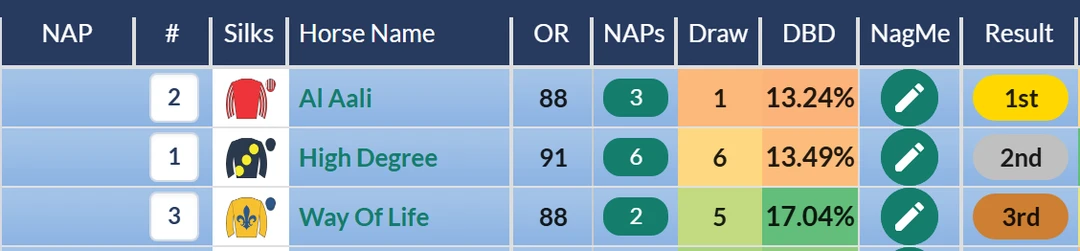
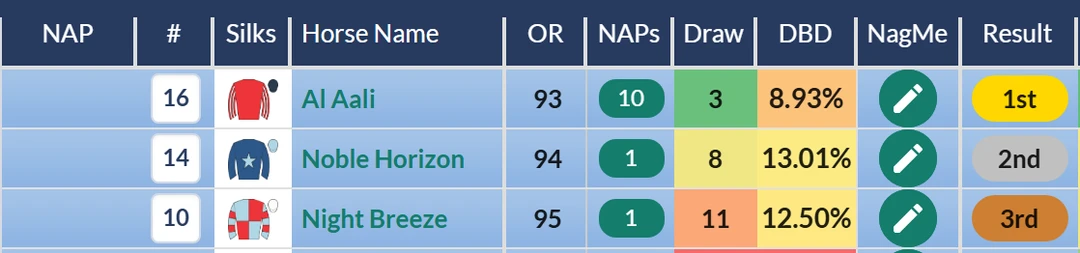
Take a real example from this summer. Al Aali won at Newmarket in July off a mark of 88, beating a well-backed favourite, and went up just 5lb to 93. We thought that rise was too small for the manner of the win, said so, and he went to Goodwood and won the Chesterfield Cup at 11/2 off the new mark. The handicapper had moved, but not far enough.
The opposite pattern is just as useful. Twilight Calls spent the summer climbing: 80, then 84, then 87, then 90, winning his way up the weights each time. A horse improving faster than the handicapper can react is worth following until the mark finally catches him.

Both cases come down to the same question. Is the official rating an accurate description of this horse right now, or is it describing the past?
Where our horse racing ratings come in
The official mark only exists for handicappers, and it only tells you what a horse must carry. It does not tell you who is likely to win a maiden, a novice event or a Group race, and it does not tell you whether today's price is fair.
Most importantly, it does not tell you whether a horse is well handicapped. It cannot, because it is the very thing being judged. The official rating is one experienced person's opinion of how good a horse is, arrived at carefully and in good faith, but an opinion all the same. Nothing in the mark itself tells you whether that opinion is right.
That is the gap our ratings are built to fill. We come at the same question from the other direction, using analysis, statistics and data rather than judgement, and the most useful thing the numbers do is test the handicapper's opinion. Does the evidence agree that this horse is worth 93? If our figures say the horse is closer to 100, then the handicapper has left something behind and that is a horse worth being on. If they say 85, the mark is too high and we leave it alone, however tempting the price looks.
That is what our own ratings are for. We rate every runner in every race, every day, and the output is a set of numbers you can sort a racecard by:
- RTR Score, our assessment of the horse's chance in today's race, in today's conditions.
- RTR Rank, the running order of that score. The number one is our Top Rated runner.
- Value Odds, the price we think the horse should be, which you can hold up against the price actually on offer.
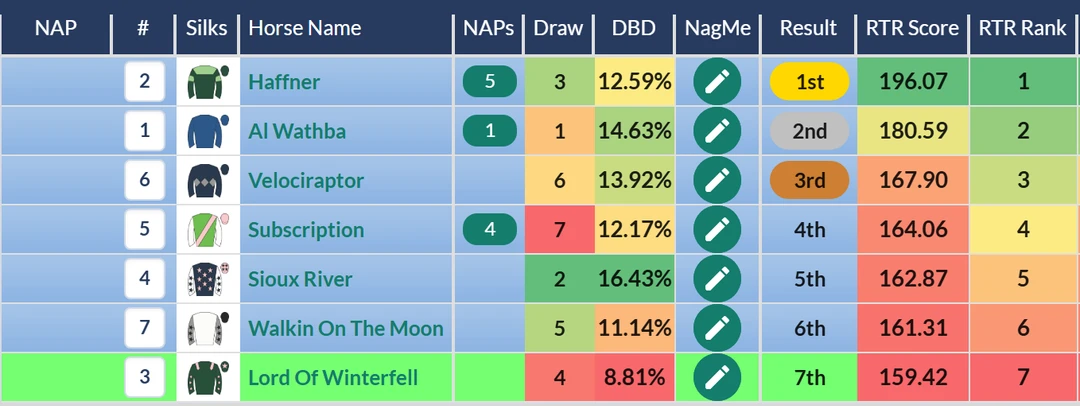
The last one is the point. A horse being our Top Rated does not automatically make it a bet. A rating tells you how good a horse is; a price tells you whether backing it makes sense. Put the two together and you have something to work with.
You can see the whole thing in action on our example ratings, and the first race of every day is free to everybody on our free horse ratings page.
Putting the two together: the weekly handicap analysis
Every week the BHA publishes its revised marks, and every week we go through them against our own numbers. That produces our Handicap Analysis series, and the job is a simple one to describe and a hard one to do well: find the horses whose new official mark disagrees with what we think they are worth.
Broadly we are looking for three things:
- Horses dropped too far, where a run of quiet efforts has pushed the mark below the horse's real level.
- Horses raised too little, where a win was better than the handicapper has credited, exactly as with Al Aali.
- Horses whose mark is fair but whose next target makes them interesting anyway, because of trip, ground or the shape of a particular race.
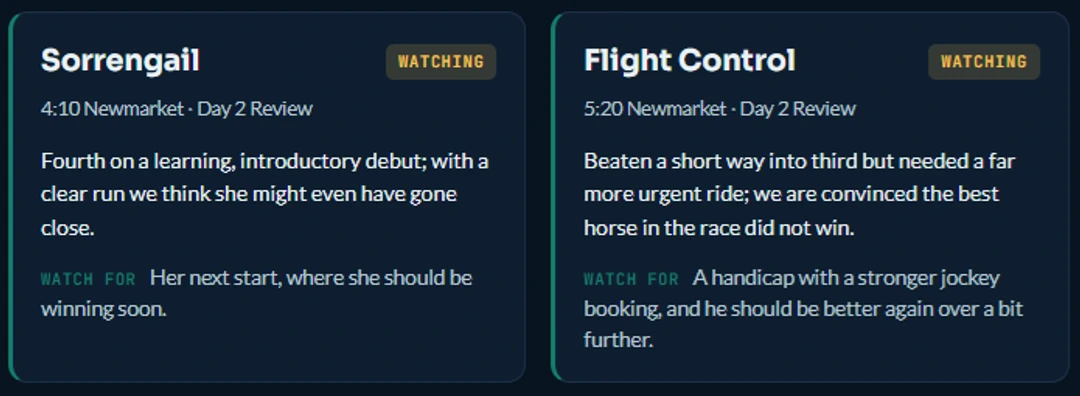
When one of those horses is worth following we put it in our tracker, so the call is on record before the horse runs rather than claimed afterwards.
How to start using ratings yourself
If you take one idea from this, make it the comparison rather than the number. A rating on its own is trivia. A rating held up against the official mark, or against the price, is an argument.
Ask three questions of any handicap runner. Does the official rating describe this horse as it is now, or as it used to be? Do our figures agree with the market's order of preference? And is the price on offer bigger than the horse deserves?
Everything you need for that is on the daily racecards, and there is more on how the numbers are built on our horse racing ratings page.