
Every so often a horse comes along whose next race tells you more about the state of race planning than it does about the horse. Danger Bay is that horse this week, and what follows is an opinion piece. We think the plan being floated for him is the wrong one, and the prize money says so out loud.
First, the horse. Danger Bay ran in the John Smith's Cup at York on 11 July, a race worth just over £103,000 to the winner, and he finished fourth. He was, as anyone watching will tell you, desperately unlucky: he travelled beautifully, got no run at all, was shuffled back after being short of room more than once, and only came home when the race was long gone. This was not a subtle piece of hard luck that only a ratings model spots. Everybody saw it.
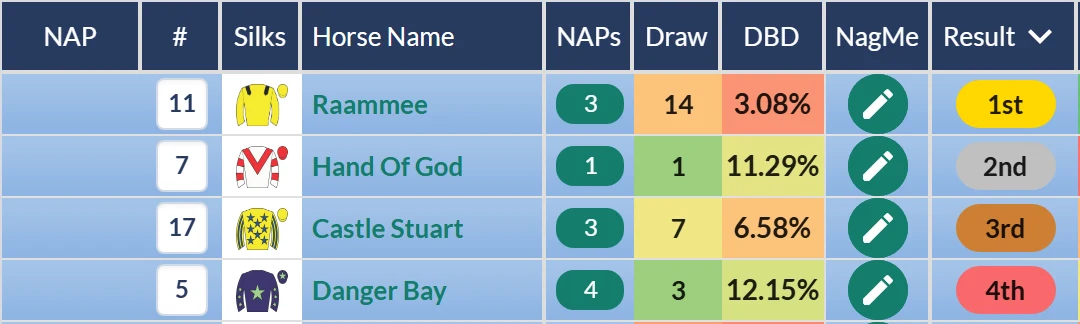
The handicapper saw it too, and put him up 2lb, from 102 to 104. Two pounds. For a horse who was never allowed to land a blow. We were not thrilled, but it is a defensible call, and it leaves him on a mark he can absolutely win off.
So where do you go with a well-handicapped, unlucky 104-rated horse?
His trainer has suggested the Rose of Lancaster Stakes, a Group 3 over 1m2f at Haydock at the start of August. And this is where we start scratching our heads, because look at what that race actually pays.
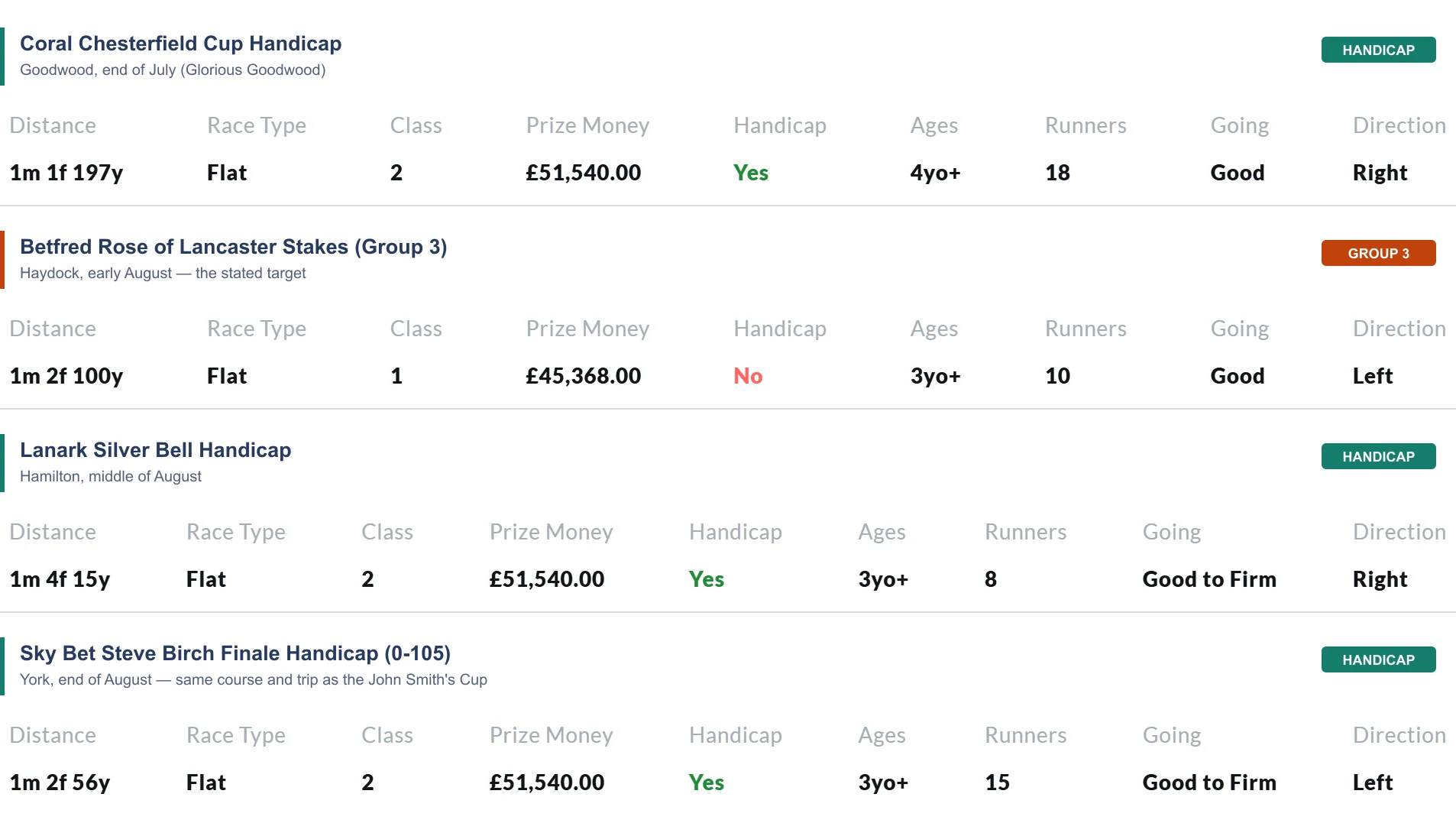
The Rose of Lancaster was worth £45,368 to the winner. Now compare that with three handicaps sitting in the same window, all of them races he is eligible for:
- The Chesterfield Cup at Goodwood, end of July: £51,540 to the winner.
- The Lanark Silver Bell at Hamilton, middle of August: £51,540 to the winner.
- The Steve Birch Finale Handicap at York, end of August: £51,540 to the winner, 0-105, over 1m2f56y.
Read that last one again. It is at York, over 1m2f56y: the same course and the same trip as the John Smith's Cup, the race he ran so well in. It is a 0-105 handicap, so on 104 he not only gets in, he gets in near the top of the weights off a mark he is arguably still ahead of. If you were designing a race for this horse on a whiteboard, you would come up with that one.
All three handicaps pay £6,172 more to the winner than the Group 3 does. So the plan on the table is to go for the race that pays the least.
The bit that really matters: the order you do it in
This is not just about one race paying more than another. It is about what winning does to you next.
Win a handicap and you have done nothing to hurt your chances in Group races, because your handicap mark is irrelevant once you step into Group company. Nobody weights you out of a Group 3 for having won a Class 2 handicap. The door stays open.
Win a Group race, though, and the handicapper looks at it and puts you up. Win the Rose of Lancaster off 104 and he is not getting into that 0-105 Finale at York afterwards. The handicap door closes behind him, and from that point on he is a Group horse whether the plan says so or not, chasing Group races that, as we have just seen, can pay him less than the handicaps he has just made himself ineligible for.
So the sequencing writes itself. Run in the handicaps through August while he is still well treated and the money is bigger. Then go to the Group races in September, which will still be there, and which no handicap win can shut him out of. Handicaps first, Groups second. Doing it the other way round is Group race, Group race, and quite possibly less money for the privilege.
And then everyone complains about prize money
Here is what grates. This is the same sport in which trainers queue up to say prize money is not good enough. And it is not good enough, in plenty of places. But of course it will never be good enough if nobody is actually targeting it. Looking at a race and thinking "that will do, it is a mile and two in a few weeks, and it is a Group 3" is not race planning. It is diary filling.
We are not having a go at one yard for the sake of it. We think this happens constantly. Races get picked on trip and date and a bit of prestige, and the prize money, the horse's mark, and the knock-on effect on the rest of the season barely get a look in. Which leads to an uncomfortable conclusion: either connections are not as hard up as the complaints suggest, or the race planning is genuinely poor. It is hard to argue for a third option when the better-paying, better-suited race is sitting right there on the same calendar.
We would love to be proved wrong. If Danger Bay goes to Haydock and wins a Group 3, that is a fine day for connections and we will say so. But we would rather have seen him go to York, over his course and distance, off a mark he is well in on, for more money, with the Group races still waiting for him afterwards.
He is in our tracker, and we will be following where he actually turns up.
A note on the placings: Danger Bay was fifth past the post in the John Smith's Cup and has since been promoted to fourth, with Salam Dubawi demoted to fifth after the stewards' inquiry. Our Day 3 review and Tuesday's handicap analysis were written before that change.